The answer lands after the decision
By the time the study is signed off, the concept is frozen and the supplier is chosen. The work was correct, thorough — and commercially irrelevant.
Agentic simulation for engineering teams
A design question is asked on Monday. The answer arrives three weeks later — after the review, after the supplier was chosen. The analysis was right. It was also too late to matter.
Describe the problem in plain language. Vyntra's AI agents run the study end to end and hand back a verified result — with the evidence behind it — while the design is still being decided.
Everything you see on this page is real — either a solve this platform ran, or a measurement from the rig we validate against, and each is labelled as such. Nothing here is an artist's impression.
Separating sand from water — solved on Vyntra, then traced to show where each phase ends up Real run
Where the time actually goes
Teams rarely lose weeks to computing time. They lose them preparing the problem, redoing work that was set up wrong, waiting behind the one person qualified to do it, and paying for the right to ask a second question.
By the time the study is signed off, the concept is frozen and the supplier is chosen. The work was correct, thorough — and commercially irrelevant.
Routine studies stack up behind the handful of people qualified to set them up. Your most expensive judgement is spent on preparation instead of on decisions.
A flaw found in test, or in the field, costs a redesign, a schedule and a customer conversation. The same flaw found in design costs an afternoon.
None of that is a computing problem, which is why more computing has not fixed it.
What it actually does
No scripting, no setup ritual, no week of preparation before the first useful number. Three steps, and your engineer is present for two of them.
Your engineer states the question the way they would explain it to a colleague: this part, these conditions, this is what I need to know.
The work is carried all the way through to a result — and checked as it goes, not hopefully at the end. Nobody has to babysit it.
Findings, the visuals to present them, and the record of how the answer was reached — produced together, not assembled afterwards by hand.
The same three steps whether it is one question or the whole design space. Asking a second time is not a second project.
Real runs on this platform
Process equipment, a drivetrain component, an occupied space, a separation duty and an advanced material. Every frame below is this platform's own output, reproduced unedited.
Red marks the volume that barely moves: the cause of long batches, inconsistent product and expensive cleaning. Found on screen, not on the shop floor.
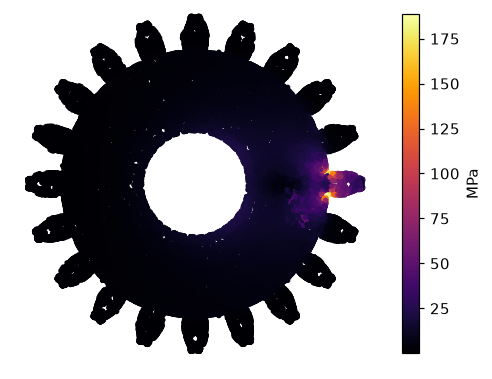
A drivetrain part taken from geometry to a verdict on both durability and noise, with the platform cross-checking its own answer before reporting it. Two warranty questions settled in design, not in the field.
Air movement through an occupied room, showing where it stalls and where it blows too hard. The same picture answers comfort complaints, energy spend and occupant-safety questions — before anything is installed.
A slurry duty run out to steady state with the solids and the liquid tracked separately the whole way. Roughly 71% of recovered solids reported to the underflow — and before the platform would quote that figure at all, it closed its own mass balance to within 0.002% of what was fed in.
Advanced materials are slow and costly to develop: most candidates fail, and each one can take months of lab time to rule out. Here the platform was asked to predict a two-dimensional sheet's atomic structure from first principles — no measurements, no fitting. It landed within 0.07% of the accepted spacing, which is how you earn the right to be trusted on a material nobody has made yet.
Visuals like these are produced as part of the run, so nobody spends a day building slides after the analysis is finished. The full engineering detail sits inside the product, for the people who need it.
What you are actually buying
Simulation capability normally arrives as a capital purchase — hardware, licences, an installation programme, a business case, and a year before anyone sees value. Vyntra arrives as a login.
Airflow through an occupied space — solved on Vyntra Real run
Ground truth
Simulation is only worth trusting if someone checked it against reality. We run our own combustion rig and hold our results to what the instruments actually recorded. Nothing below is a simulation — it is the measurement.
A real flame burning behind a real obstacle, recorded on our own high-speed camera and slowed down thirty-three times so you can see what it does between one millisecond and the next. This is the behaviour that decides whether a burner runs smoothly or tears itself apart.
Subtract the steady average and what is left is the part that moves: red where the flame is surging, blue where it is falling away, rolling downstream in an alternating pattern. This is the oscillating, recirculating flow that engineers need predicted correctly — shown here as the camera saw it.
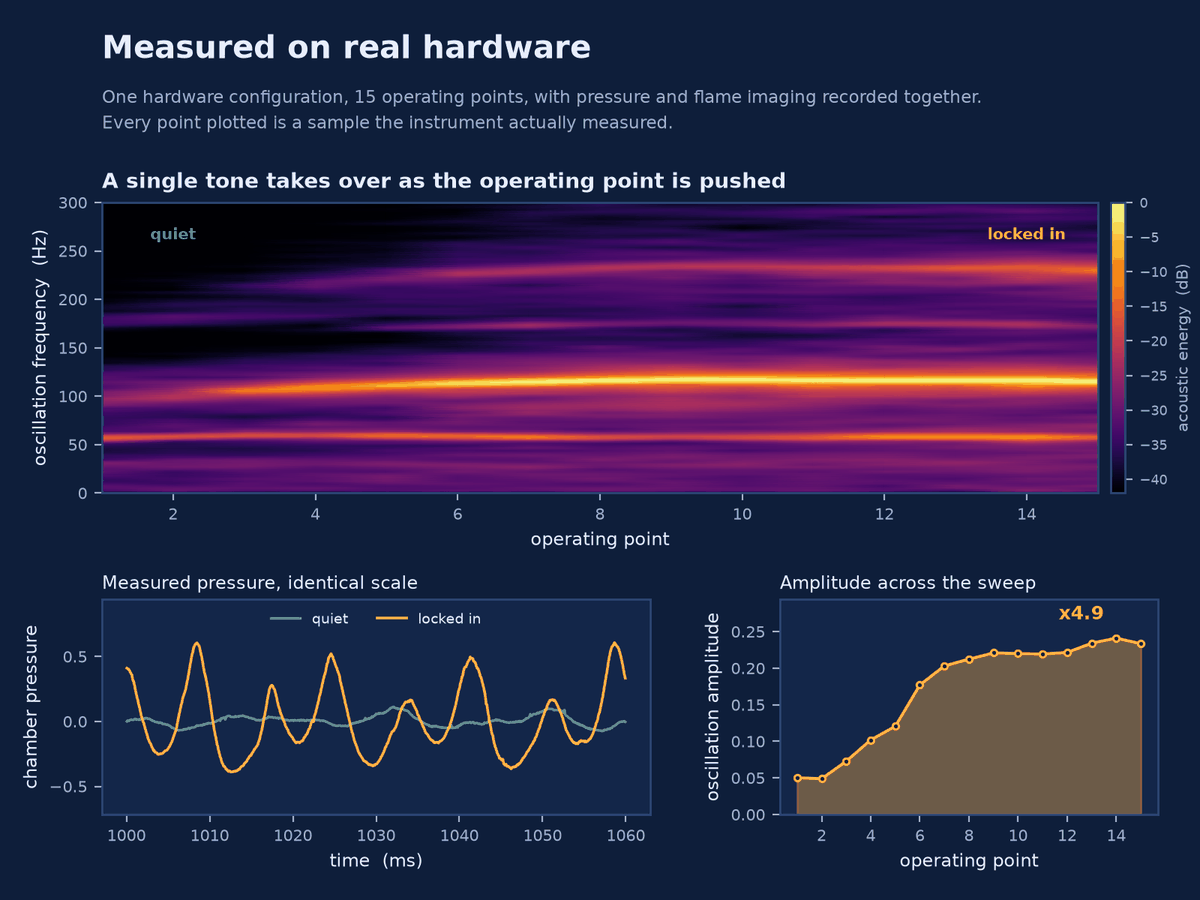
Pushed across its operating range, the chamber stops being quiet and locks onto a single loud tone — the oscillation grows almost five times in amplitude. Discovered late, this is the kind of problem that costs a redesign and a schedule. Predicting it early is exactly the work this platform exists to do, and these recordings are the yardstick we hold it to.
Our own rig, our own instruments, our own data. We are not publishing the hardware, the geometry or the test programme behind it — but we will walk your engineers through the comparison against it under NDA.
Why the board can rely on it
Engineering decisions carry liability — to your customer, your insurer, your regulator. AI is only useful here if it shows its work and admits what it does not know.
The point of speed is not speed. It is that the answer arrives while you can still act on it.
Every result arrives with the evidence behind it, so reviews and audits move forward instead of stalling.
A number that looks right and is not is the most expensive thing a simulation can produce.
We hold the platform to instrument data from our own rig, not to its own opinion of itself.
The commercial case
The largest line item in most simulation budgets is the right to open the software at all. Remove it and the constraint on how much engineering your team does in a week stops being procurement.
No licence linesimulation software cost
Traditional tools charge per engineer and per concurrent job. That line does not appear here, and it does not reappear as the team grows.
No queuewaiting for a free seat
Licences are a hidden cap on throughput. Remove them and how much engineering gets done is set by the work, not by what was bought last year.
Ask twicefor the cost of asking once
When a second option is effectively free, teams find the better design instead of defending the first one that passed. That is where the margin is.
We will model Vyntra against your current simulation spend during the pilot, using your own numbers, before you commit to anything.
Who this is built for
Built for teams whose products fail expensively — launch vehicles, airframes and UAVs, rotating machinery, process and pharmaceutical plant, and the engineering firms that serve them.
Deployable into your own cloud tenancy where data residency or export control requires it.
Hand us a case where you already know the answer. We will run it, put our result next to yours, and show you what it would have cost and how long it would have taken — before you commit to anything.
Or write to us directly: [email protected]